


Every growing business eventually faces the same challenge: systems don’t talk to each other. Finance uses one application, HR uses another, the supply chain uses something else, and customer operations often run on completely separate tools. When these systems don’t communicate, teams end up working in silos, data becomes inconsistent, and business decisions slow down.
Oracle Integration Cloud (OIC) solves exactly this problem. It acts as the central connection layer of an enterprise, moving data between systems, triggering processes, and making sure information flows smoothly across cloud, on-premise, and third-party applications. This blog explains what OIC is, why it matters, what businesses can do with it, and how Faramond helps organizations use it effectively.
What Is Oracle Integration Cloud?
Oracle Integration Cloud is a cloud-based platform that lets companies integrate systems without writing complex custom code. It provides ready-to-use connectors, visual integration flows, process automation tools, and API management capabilities. In simple words, OIC helps applications exchange information quickly, securely, and reliably so the business stays in sync.
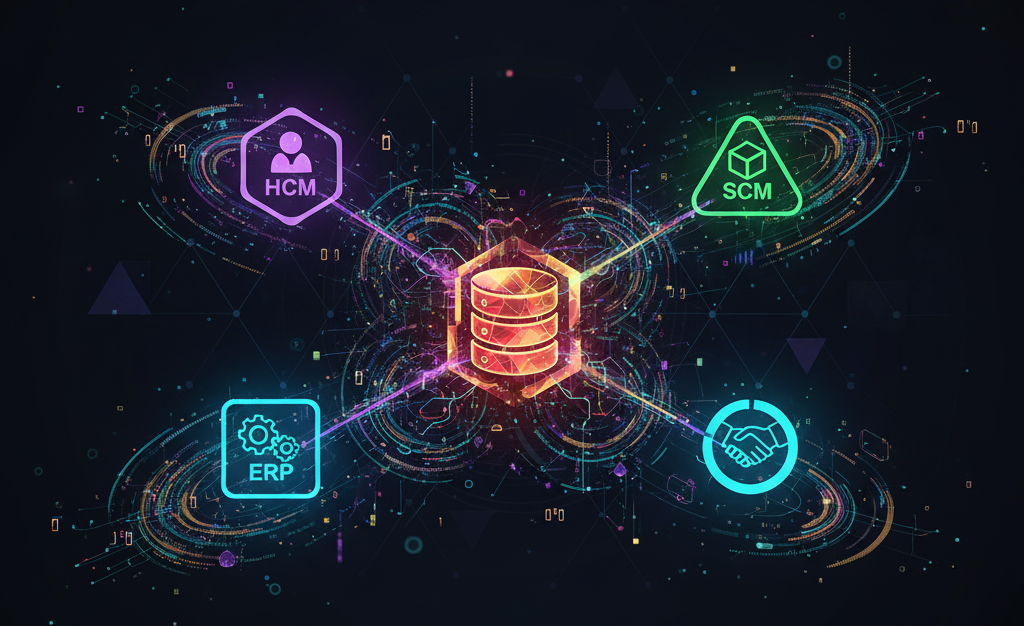
With OIC, companies can connect Oracle Fusion Applications (ERP, HCM, SCM, CX), on-premise systems, databases, third-party SaaS tools, vendor portals, and even custom-built applications. The goal is to automate the flow of information and eliminate manual work across departments.
Why Do Businesses Need a Platform Like OIC?
Without a unified integration platform, businesses rely on point-to-point scripts, manual file transfers, or disconnected spreadsheets. This creates delays, errors, and unnecessary overhead. Data becomes inconsistent, people waste time reconciling information, and systems depend on fragile custom code that breaks during upgrades or environment changes.
OIC makes integrations predictable and centralized. When a company adopts Oracle Fusion or expands into multiple systems, OIC becomes essential to ensure consistent data, real-time updates, and seamless business operations. It also brings governance, security, monitoring, and transparency to all data flows.
What Can Businesses Achieve with OIC?
The real value of OIC appears in everyday scenarios across industries. For financial systems, OIC can synchronize suppliers, customers, invoices, payments, and receipts across ERP and external platforms. For HR, it connects attendance systems, payroll engines, and identity management tools. Manufacturers use OIC to integrate MES, plant systems, and logistics partners with ERP and supply chain modules. Retailers connect ecommerce platforms with order management, inventory, and finance. In pharma and regulated industries, OIC integrates LIMS, quality systems, and compliance tools to maintain accurate and traceable records. Even in managed IT environments, OIC helps unify legacy systems with cloud applications in a controlled and secure manner.
Key Capabilities That Matter to Engineers and Architects
One of the biggest strengths of OIC is the library of prebuilt adapters for Oracle Fusion, databases, REST/SOAP services, file servers, event streams, and popular SaaS providers. Engineers don’t have to spend days establishing connectivity. OIC’s visual integration designer allows teams to focus on business logic instead of low-level plumbing. The platform also supports process automation, meaning businesses can build multi-step workflows that coordinate actions across different applications. OIC’s API management capabilities let organizations expose integrations as secure APIs, add throttling rules, and monitor traffic. Its built-in dashboards show which integrations are running, delayed, or failing, helping support teams resolve issues quickly. OIC also integrates deeply with Oracle security, identity, and network frameworks, which is important for industries that require strict control and auditability.
Business Benefits of Using OIC
Companies using OIC experience faster project delivery because integrations are built with drag-and-drop mapping instead of custom code. Prebuilt templates and connectors reduce the overall integration cost and make the system easier to maintain. Centralized monitoring improves reliability and eliminates the need to manually track failed jobs or missing files. Better data quality means better decisions, faster reconciliations, and fewer operational bottlenecks. As the business grows, OIC provides the flexibility to connect new applications without major redesign.
How Faramond Helps Companies Succeed with OIC
Faramond supports organizations across ERP, HCM, SCM, and custom application landscapes to build clean, scalable integration strategies. We design architecture frameworks, establish integration standards, and help companies decide how different systems should communicate. Our engineering teams build integrations for financial data exchange, supply chain visibility, HR and payroll automation, ecommerce syncing, and industry-specific workflows. We also create reusable components such as error frameworks, notification engines, and mapping templates so future integrations take less time and effort.
In many cases, companies need lightweight applications on top of their integration flows. We build these using Oracle APEX and VBCS—dashboards, correction screens, business workbenches, or trackers—without modifying ERP’s core. For customers who prefer continuous support, our managed integration services offer monitoring, enhancements, and version-release validation, ensuring the integration layer stays healthy long after implementation.
Conclusion
In today’s digital world, integrations are not just technical utilities. They directly impact business speed, customer experience, and decision-making. Oracle Integration Cloud gives companies a reliable, scalable, and future-ready platform to unify their systems. When implemented thoughtfully, it becomes a long-term strategic asset that supports every new project, initiative, and digital transformation roadmap.
With deep expertise across Oracle Fusion, OCI, OIC, APEX, VBCS, and managed IT operations, Faramond helps organizations design and operate integration ecosystems that are clean, modern, and built for growth.